Showing posts with label Global Health. Show all posts

August 28, 2008

Bad Teeth Per Person

Lots to catch up on but this new addition to Gapminder World needs to be passed on:
We have added a new indicator: “bad teeth per person” (you find it under “health” in the Gapminder World).
Here we have plotted “bad teeth per person” against “income per person”.  Is dental problems worst in the richest or the poorest countries?  There actually seem to be a tendency for the dental problems to be larger in the middle income countries, while the population in the richest and poorest countries have somewhat better teeth.
“Bad teeth per person” show how many decayed, missing or filled teeth an average 12 year old has in each country. The technical term of the indicator is DFMT for 12-years old and the data is taken from the WHO. We have unfortunatly only data for one year. Note that the data in many cases are actually based on estimates for earlier years.  
Why is Saudi Arabia so high I wonder?  Their BTPP is almost twice as high as the next highest Middle-Eastern nation.  They have a high number of medical doctors and at least average health expenditure per capita.  Is there something culturally that would account for an aversion to dentistry or maybe something in (or not in) the diet that would lend itself to bad teeth?


August 1, 2008

TB, Loans and the IMF

An interesting pointer from the Poverty News Blog to this short article in the NYT.
The rapid rise in tuberculosis cases in Eastern Europe and the former Soviet Union is strongly associated with the receipt of loans from the International Monetary Fund, a new study has found.

Critics of the fund have suggested that its financial requirements lead governments to reduce spending on health care to qualify for loans. This, the authors say, helps explain the connection.

The fund strongly disputes the finding, saying the former communist countries would be much worse off without the loans.

“Tuberculosis is a disease that takes time to develop,” said William Murray, a spokesman for the fund, “so presumably the increase in mortality rates must be linked to something that happened earlier than I.M.F. funding. This is just phony science.”

The researchers studied health records in 21 countries and found that obtaining an I.M.F. loan was associated with a 13.9 percent increase in new cases of tuberculosis each year, a 13.3 percent increase in the number of people living with the disease and a 16.6 percent increase in the number of tuberculosis deaths.

The study, being published online Tuesday in the journal PLoS Medicine, statistically controlled for numerous other factors that affect tuberculosis rates, including the prevalence of AIDS, inflation rates, urbanization, unemployment rates, the age of the population and improved surveillance.

The lead author, David Stuckler, a research associate at Cambridge University, defended the study against the fund’s criticisms, noting that the researchers considered whether increased mortality might have led to more loans rather than the other way around.

Instead, they found that the increase in tuberculosis mortality followed the lending; each 1 percent increase in credit was associated with a 0.9 percent increase in mortality. And when a country left an I.M.F. loan program, mortality rates dropped by an average of 31 percent.

“When you have one correlation, you raise an eyebrow,” Mr. Stuckler said. “But when you have more than 20 correlations pointing in the same direction, you start building a strong case for causality.”
More here, from here, the report is here.  

July 22, 2008

Declining U.S. HDI and Life Expectancy

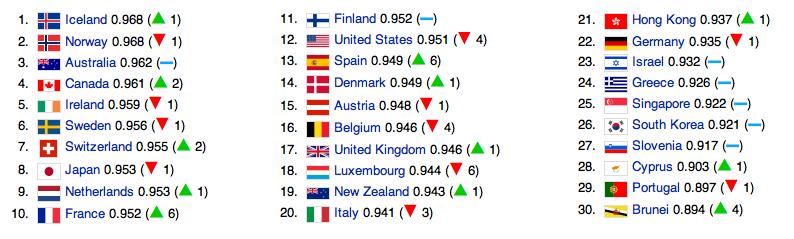
More on health and disparity with news that the U.S. has dropped four spots in the Human Development Index.  
Here's the state by state map:

/

Here's the changes in the top 30 countries from Wikipedia:

/

July 21, 2008

HIV/AIDS: A Rural/Southern Epidemic?

UPDATE: The Daily Dish points to another map reflecting disparities in US health/life expectancy, this one ranked by congressional district.  Not surprisingly, the bottom five contains two districts from Mississippi and two from Louisiana - I assume that the bottom of the bottom is an Appalachian district, and that the top of the top is peopled by congressional aides.  Here's the source.

/

This is one of several emerging trends that reflect a decline of the overall health of those living in rural portions of the deep South:
"Rising infection rates, coupled with inadequate funding, resources and infrastructure have resulted in a catastrophic situation in our public health care systems in the South," the report says.
Kathy Hiers, chief executive officer of AIDS Alabama and co-author of the report, told The Birmingham News that HIV/AIDS is taking hold in isolated parts of the South.
"The ruralness of the epidemic is what's becoming painfully clear," Hiers told the paper.
The report says the number of deaths from AIDS dropped in the rest of the nation between 2001 and 2005 but continued to increase in the South.
Health authorities have known for years that the 16-state Southern region was leading the country in the number of new infections. But, Hiers said, they thought the increase was concentrated in big cities in Florida, not spread across the region.
Experts have now focused in on the Deep South - Alabama, Georgia, Louisiana, Mississippi, North Carolina and South Carolina. They have found HIV infections rising in rural areas populated by blacks with financial, health and social problems.
Gary A. Puckrein is the president and CEO of National Minority Quality Forum in Washington. He said the shift in HIV infections has to be highlighted.
"Certainly one of the big misconceptions is it is big cities on the West Coast and East Coast that are really driving the disease, and it's not so," Puckrein said. "It's moved both in terms of geography and demography. It's really important for people in Southern states to know that because they're not getting their fair share of support."
This image is from the much reported story earlier in the year on declining life expectancy in the South, especially among women:

/

May 14, 2008

World Bank committed, the Senate . . . not so much

The World Bank released their new agenda for action on HIV/AIDS in Africa today.  Entitled "Our Commitment: World Bank's Africa Region HIV/AIDS Agenda for Action 2007-2011" it does pretty much what it says - lays out the World Bank's plan of action for dealing with HIV/AIDS in Africa over the next four years. I've only perused it so far, you can download it here, but it attempts to make the case for how the World Bank is going to move their focus from emergency relief mode to long-term, sustainable development mode by integrating their HIV/AIDS response into broader development efforts that take into account the changing dynamics of the epidemic.  With new infections still on the rise in Africa it will be interesting to see how these efforts play out on the ground and in what areas of the pandemic it is actually feasible to shift from relief to development.  It also acknowledges the World Bank's shift from the role of major funder for HIV/AIDS programs to that of "development partner and complementary funder."  In that new role it lays out these goals for the agenda:

• Strengthen the long-term prioritized sustainable response through incorporating HIV/AIDS more explicitly into national development agendas, focusing the response, articulating realistic strategies built on solid evidence generated by good M&E, and integrating HIV/AIDS efforts with those of other diseases.
• Intensify and accelerate a targeted multisectoral response by interventions in
education, transport, agriculture, and health; and by working with the private sector, CSOs, and local governments.
• Build stronger national systems to manage the response effectively and efficiently in health service delivery, financial management and procurement, supply chain management, human resources, and social services.
• Strengthen donor coordination by maintaining the commitment to the Three Ones and working effectively to rationalize the global aid architecture for health.
Ironically enough one of the funding sources that has supplanted the World Bank as a major donor for HIV/AIDS programs in Africa, PEPFAR, also found itself in the news today but for much less laudatory reasons.  Sadly this type of behavior is nothing new, although, as I mentioned previously, I still think President Bush is going to see this as a legacy issue (what other options does he have?) and go to bat for it in the end.

March 5, 2008

You Better Watch Your Ass Dracunculiasis

As far as I can determine this is the list of diseases slotted for eradication/elimination by the International Task Force for Disease Eradication and the WHO.

International Task Force for Disease Eradication - Sanctioned by The World Health Organization

Eradication and Elimination Programs Currently Sanctioned by The World Health Organization

Eradication
Dracunculiasis (Guinea worm disease): 1988 AFRO, 1991 WHA44.5, 2004 WHA 57.9. Target: 1995; revised to 2009

Poliomyelitis: 1988 WHA41.28. Target: 2000

Elimination
Neonatal tetanus: Original target: 1995.1989 WHA42.32 (environmental)

Leprosy: 1991 WHA44.9. Target: reduce cases to <1>Onchocerciasis (West Africa OCP): 1973 Agreement. Target: eliminate onchocerciasis "as a public health
 problem" in OCP area by 2002 (qualitative)

Onchocerciasis (Americas): 1991 PAHO:XIV. Target: eliminate "as a public health problem in the Americas" (morbidity) by 2007 (qualitative geographic)

Trachoma: 1998 WHA51.11. Target: "global elimination of blinding trachoma" (informally: by 2020; "GET 2020") (symptomatic)

Lymphatic filariasis: 1997 WHA50.29. Target: eliminate globally "as a public health problem" (informally: by 2020) [cites International Task Force for Disease Eradication]


Note:
WHO Press Release in March 1997 reports that leprosy, river blindness (onchocerciasis), Chagas' disease, and lymphatic filariasis "can be eliminated as public health problems within ten years"; cites a new report by the Special Program for Research and Training in Tropical Diseases.

Article in The New York Times, dated May 6, 2001 ("Ten Diseases on the Way Out"), names polio, Guinea worm, measles, lymphatic filariasis, river blindness, blinding trachoma, leprosy, hepatitis B, maternal/neonatal tetanus, and iodine deficiency disorders.

And while you might think that such a list would contain, well, you know, EVERY disease there are apparently good reasons why it doesn't.  
Prompted by this article in yesterday's NYT and in light of this previous post.
Also worth a look:  For those interested the Malaria Atlas Project makes available some great maps and data on global malaria stats.